The Most Misunderstood Room in Any Hospital
Of all the places in EPIC Multispecialty Hospital, Ahmedabad, the intensive care unit generates the most anxiety — for patients going in, and for families waiting outside. The image of the ICU in most people’s minds is shaped by medical dramas: chaos, urgency, a place where people go when things are desperate.
The reality is quite different. The ICU is a place of extraordinary attention to detail — where highly trained nurses monitor every patient’s vital signs continuously, where doctors review blood results and medication adjustments multiple times daily, and where the goal is stability, recovery, and the transition back to the ward as quickly as safely possible.
I am a critical care specialist, and I have spent my career in intensive care units. I want to give families in Ahmedabad a clear, honest picture of what the ICU is, what it does, and why admission to an ICU — while serious — is often a sign that the right level of care is being delivered, not that something terrible is happening.
Why Patients Are Admitted to the ICU
ICU admission is indicated whenever a patient needs a level of monitoring or support that a regular ward cannot provide. This includes patients recovering from major surgery — cardiac, abdominal, thoracic — where the physiological changes of the post-operative period require continuous monitoring. It includes patients with serious infections who need intravenous antibiotics, fluid management, and organ support. It includes patients with respiratory failure who need support for their breathing, and patients with cardiac events who need continuous cardiac monitoring.
Admission to the ICU is not a sign of hopelessness. It is a sign that the clinical team has identified that this patient needs more intensive support than a ward can provide — and has arranged that support proactively. Many ICU admissions are planned: a patient undergoing major surgery at EPIC Multispecialty Hospital, Ahmedabad, will typically have a planned ICU stay built into the post-operative pathway.
Most patients who are admitted to the ICU go home. The majority leave the ICU to the ward within two to five days. Some complex admissions take longer. But the trajectory for most patients, with good critical care, is recovery.
The Equipment — What It All Means
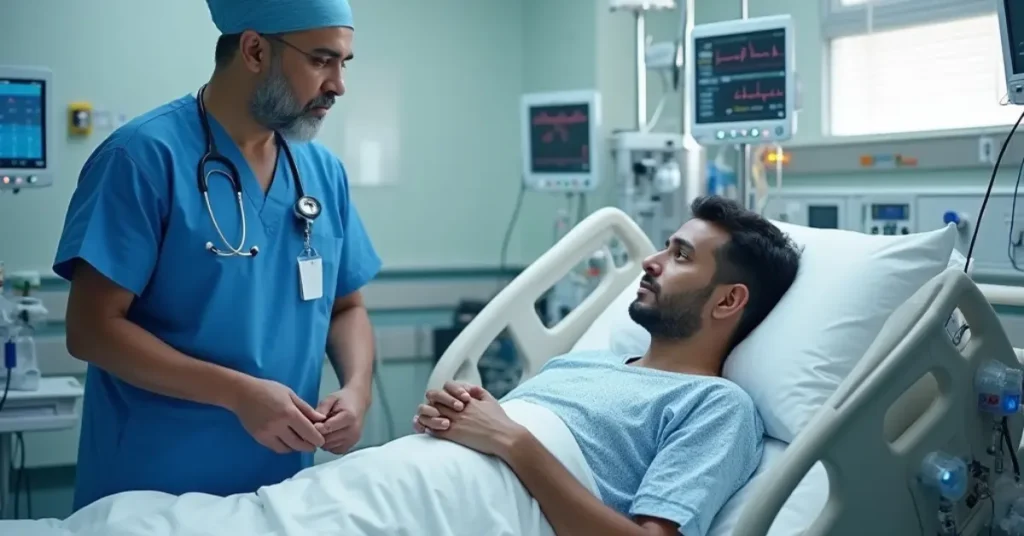
Walking into the ICU and seeing a family member surrounded by monitors, lines, and machines can be overwhelming. Let me explain what you are seeing.
The cardiac monitor shows the heart’s rhythm in real time — any change is noticed immediately by the nursing team. The blood pressure cuff or arterial line provides continuous blood pressure monitoring, far more accurate than the intermittent cuff checks on a ward. The oxygen saturation probe on the fingertip tells us how well the lungs are oxygenating the blood.
If the patient is on a ventilator — a breathing machine — this means they need support with breathing, either because their own breathing is not sufficient to maintain safe oxygen and carbon dioxide levels, or as planned support after surgery while anaesthetic agents clear the system. The ventilator is managed carefully and weaned as the patient’s ability to breathe independently returns.
Intravenous lines deliver medications directly into the bloodstream — antibiotics, blood pressure medications, sedation, nutrition. The urine catheter measures urine output hourly, one of our most sensitive indicators of kidney function and overall circulation.
All of this equipment serves one purpose: to give us information and tools to support the body while it recovers. As that recovery progresses, the equipment is progressively removed.
What Family Members Can Do — and What Helps
Family members sometimes feel helpless in the ICU. They want to do something — and there are genuinely helpful things they can do.
Talk to your family member, even if they seem unresponsive or sedated. Hearing a familiar voice is meaningful, even to a heavily sedated patient. Some patients describe hearing family voices during ICU stays even when they appeared to be unconscious. Touch — holding a hand, gently stroking an arm — matters.
Bring familiar items if permitted — a photograph, a small object from home. Familiar sensory cues help with orientation, particularly as sedation lightens.
Ask questions when the medical team is available. At EPIC Multispecialty Hospital, Ahmedabad, we hold regular family meetings during prolonged ICU stays to ensure families understand what is happening, what the plan is, and what the realistic expectations are. If you do not understand something, please say so. Clarity reduces anxiety, and your questions are always welcome.
Recovery and Transition — What Leaving the ICU Looks Like
The transition from the ICU to the ward is a good day — for the patient, for the family, and honestly for us too. It means the acute phase of illness has stabilised, the intensive monitoring and support are no longer required, and the patient is on a trajectory toward home.
After the ICU, patients typically need some days of continued recovery on the ward — further physiotherapy, medication adjustment, nutritional rehabilitation — before discharge. Some patients need a period of rehabilitation after prolonged ICU stays, particularly if there has been significant deconditioning of the muscles during the critical illness.
ICU survival is not the end of the story — it is the beginning of recovery. And recovery from a critical illness, supported by good rehabilitation, is often more complete than families initially believe possible. I have seen patients leave my ICU who were on ventilators for weeks go home and return to full, active lives. It takes time, patience, and good support — but it happens more often than people fear.
Common Questions Patients Ask
How often can family members visit the ICU?
Visiting hours at EPIC Multispecialty Hospital, Ahmedabad, are set to balance family access with the patient’s need for rest and the nursing team’s ability to deliver care without interruption. In general, two to three visiting periods per day are standard, with flexibility for immediate family in difficult situations. The nursing team will guide you.
What does it mean if the patient is sedated?
Sedation in the ICU is deliberate and managed carefully. It reduces the patient’s awareness of uncomfortable procedures and equipment, reduces oxygen demand, and allows the ventilator to support breathing effectively. Sedation is regularly lightened and reassessed — we aim to use the minimum sedation necessary.
Is it normal for ICU patients to feel confused when they wake up?
Yes — ICU delirium, a state of confusion and disorientation, is very common in critically ill patients, particularly the elderly. It is caused by the illness itself, the medications, sleep disruption, and the disorienting ICU environment. It usually resolves as the patient improves and moves to the ward, but in some patients it takes several days to weeks.
Will the patient remember their ICU stay?
Many patients have little or no memory of their ICU stay, particularly the periods of heavy sedation. Some remember fragments — sounds, voices, sensations. ICU-related memories can occasionally be distressing, and our team at EPIC Multispecialty Hospital, Ahmedabad, provides follow-up support for patients and families who experience this.
What questions should I ask the ICU team?
Good questions to ask include: What is the main problem being treated? What is the current plan? What are the goals for today and tomorrow? What are we watching for as signs of improvement or concern? When might my family member be ready to move to the ward? These are all reasonable questions that our team at EPIC Hospital Ahmedabad welcomes.