LIMA/BIMA Grafting in Bypass Surgery – One Question That Changes Everything
If you have been told you need bypass surgery in Ahmedabad – or anywhere in Gujarat – there is one question that most patients never think to ask, and that most hospitals never voluntarily explain: what will my bypass grafts actually be made from?
The answer to that question matters more than almost any other technical decision in your operation. LIMA and BIMA grafting – using the arteries running along the inside of your chest wall as the bypass conduits, rather than a vein from the leg – produces results that are dramatically better over 10 to 20 years. At EPIC Multispecialty Hospital in Ahmedabad, arterial grafting is our standard approach. Here is why you should care about that.
What LIMA and BIMA Actually Mean
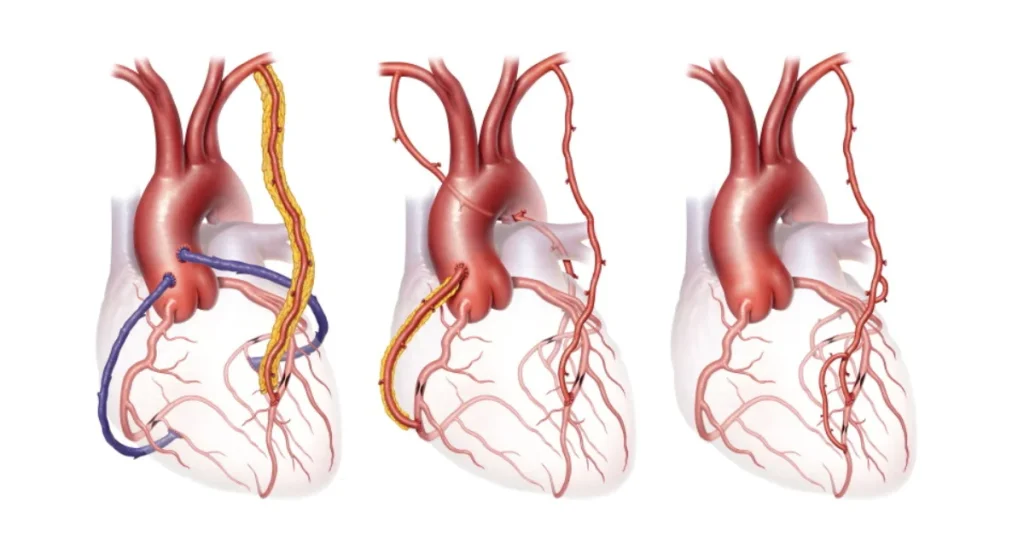
- LIMA – Left Internal Mammary Artery: An artery that runs along the inside of the left chest wall. When used to bypass the left anterior descending coronary artery – the most critical vessel in the heart – LIMA graft patency exceeds 95 percent at 10 years. Nothing else in bypass surgery comes close to that number. Using the LIMA for this bypass is widely considered the single most important technical achievement in the entire operation.
- BIMA – Bilateral Internal Mammary Arteries: Using both internal mammary arteries – left and right – provides a second arterial conduit for additional bypass targets. Studies consistently show that BIMA grafting reduces the need for repeat procedures and improves long-term survival compared to a single arterial graft plus veins – particularly in patients under 65 to 70 years of age.
- Why vein grafts fall short over time: Saphenous vein grafts taken from the leg work well in the first few years. But they undergo a process of accelerated hardening of the arteries – the same disease that blocked the original coronary arteries. Within 10 years, research shows 40 to 50 percent of vein grafts have significant disease or have failed. Patients return with blocked grafts and need repeat intervention. Arterial grafts do not follow this pattern.
- Radial artery grafting: The radial artery from the wrist is a third arterial option, used alongside LIMA or BIMA for additional bypass targets. It performs better than vein in most anatomically suitable cases and is part of a full arterial revascularisation approach.
Who Is Suited to BIMA Grafting – and the Honest Trade-Off
BIMA grafting is not right for every patient, and being honest about that is important. When both internal mammary arteries are harvested from the chest wall, the blood supply to the sternum – the breastbone – is reduced. In patients with diabetes, significant obesity, or poor tissue circulation, this increases the risk of deep sternal wound infection after surgery. That is a serious complication.
For this reason, BIMA is generally best suited for non-diabetic or well-controlled diabetic patients who are not significantly overweight, are under 70 years of age, and are having planned rather than emergency surgery. The younger and fitter the patient, the more the long-term benefit of BIMA outweighs this additional consideration.
For patients who do not meet these criteria, LIMA plus vein graft or LIMA plus radial artery remains an excellent approach. What matters is that the decision is made deliberately and specifically for each patient – not that everyone gets the same operation because it is easier or faster.
LIMA/BIMA Grafting at EPIC Hospital in Ahmedabad – Questions Answered
Is LIMA/BIMA arterial grafting standard at EPIC Hospital?
Yes. Arterial grafting – LIMA as a minimum, BIMA where appropriate – is our standard approach for bypass surgery at EPIC Hospital in Ahmedabad. We do not default to vein grafts unless there is a specific clinical reason to do so. Your surgeon will explain the planned graft strategy for your case before the operation.
Does BIMA grafting make my operation more risky?
It adds approximately 20 to 30 minutes to the operative time and carries the sternal healing consideration described above. In appropriately selected patients, the overall operative risk is not meaningfully higher – and the long-term benefit is significant. In patients who are not good candidates, we do not push it.
Should I ask my surgeon about graft strategy before my bypass surgery?
Absolutely – and you should ask specifically, not just accept a general answer. Ask which graft will be used for which vessel, whether arterial or vein, and why. At EPIC Hospital in Ahmedabad, our surgeons discuss this with every bypass patient as part of the standard pre-operative conversation.
What happens to the wrist if the radial artery is used as a graft?
Before using the radial artery, we confirm with a simple test that the hand has adequate alternative blood supply through the ulnar artery. If the test is satisfactory, the radial artery can be taken safely with no significant long-term impact on hand function.
Ask About Your Graft Strategy – It Matters More Than Most Patients Know
LIMA and BIMA grafting in bypass surgery is not a niche technical detail. It is the difference between a bypass that lasts and one that needs revisiting in 10 years. At EPIC Multispecialty Hospital in Ahmedabad, we choose the best graft for each patient – and we explain the reasoning clearly.
Book a consultation with our bypass surgery team online, call us today, WhatsApp your coronary angiography for a graft strategy discussion, or visit EPIC Hospital in Ahmedabad – and ask the question that most patients never think to ask.