
Head Injury Treatment in Ahmedabad - Expert Neurological Emergency Care at EPIC
Head injuries are among the most feared medical emergencies – and with good reason. The brain is the most complex organ in the human body, enclosed in a rigid skull that offers no room for expansion. When it is injured – whether by a blow, a fall, a road accident, or a penetrating object – the consequences can range from a brief confusion to permanent disability or death. The quality of initial assessment, imaging, and management in the hours after injury shapes every outcome that follows.
EPIC Multispecialty Hospital, Ahmedabad provides comprehensive head injury treatment in Ahmedabad – from rapid CT brain imaging and neurosurgical assessment for severe traumatic brain injury (TBI), to careful observation and protocol-driven management for mild concussion. Our neurosurgery and critical care teams are available 24 hours a day.
Understanding Head Injuries – Classification and Severity
Mild Head Injury (Concussion)
A mild TBI or concussion involves a brief alteration in consciousness – confusion, disorientation, or a short loss of consciousness (typically under 30 minutes) – with a Glasgow Coma Scale (GCS) score of 13–15. CT brain may be normal. Most patients recover fully, but a subset develop post-concussion syndrome – persistent headaches, cognitive difficulties, and mood changes requiring specialist follow-up.
Moderate Head Injury
Moderate TBI is defined by a GCS of 9–12, loss of consciousness for 30 minutes to 6 hours, and post-traumatic amnesia of up to 24 hours. CT brain typically shows abnormalities. These patients require admission, neurosurgical assessment, and close neurological observation for deterioration.
Severe Head Injury
Severe TBI – GCS 8 or below – requires immediate airway management, CT brain imaging, neurosurgical assessment, and ICU admission. Common findings include extradural haematoma (EDH), subdural haematoma (SDH), subarachnoid haemorrhage (SAH), intracerebral haemorrhage, diffuse axonal injury (DAI), and cerebral oedema with raised intracranial pressure (ICP)
Head Injury Treatment at EPIC Multispecialty Hospital
Emergency Assessment and Imaging
Every head injury patient at EPIC Hospital receives immediate neurological assessment using the Glasgow Coma Scale (GCS), followed by urgent CT brain and CT angiography where indicated. The combination of clinical assessment and imaging guides the decision to observe, admit, or operate.
Neurosurgical Intervention
When imaging identifies a surgically amenable lesion – an extradural haematoma compressing the brain, a large subdural haematoma causing midline shift, a depressed skull fracture, or acute hydrocephalus – EPIC’s neurosurgical team proceeds to emergency craniotomy, craniectomy, or burr hole drainage. Speed from diagnosis to theatre directly impacts neurological outcome, and EPIC Hospital’s 24/7 neurosurgical availability makes this possible at any hour.
ICU Management of Severe TBI
Severe TBI patients require multimodal ICU monitoring – continuous ICP monitoring, cerebral perfusion pressure (CPP) optimisation, mechanical ventilation, temperature management, and seizure prophylaxis. The principles of neuroprotection – avoiding secondary brain injury from hypotension, hypoxia, raised ICP, and pyrexia – are followed meticulously by EPIC’s critical care and neurosurgery teams.
Why Families Choose EPIC for Head Injury Treatment in Ahmedabad
- 24/7 neurosurgical capability – emergency craniotomy at any hour
- Immediate CT brain imaging with radiology reporting on arrival
- Dedicated neuro-ICU protocols for severe TBI management
- Integrated neurology, neurosurgery, and critical care teams
- Neuro-rehabilitation programme for recovery after severe TBI
Know Your Signs

Stomach/Abdominal Pain
Heartburn
Loss of appetite
Blood in stools
Blood vomiting
Diarrhea (acute & chronic)
Unexplained weight loss or weight gain
Difficulty in swallowing
Emergency Services
Our dedicated emergency team is available 24/7 to provide immediate medical care and support in critical situations.

Get In Touch
BOOK AN APPOINTMENT
Find Best Critical Care Hospital in Ahmedabad

Multidisciplinary Team of Experts
Dedicated Trauma Center
40 bedded ICU & Critical Care Unit
Inhouse Blood Bank /Pathology /Radiology
24/7 Emergency & Ambulance Service (ICU on wheel)
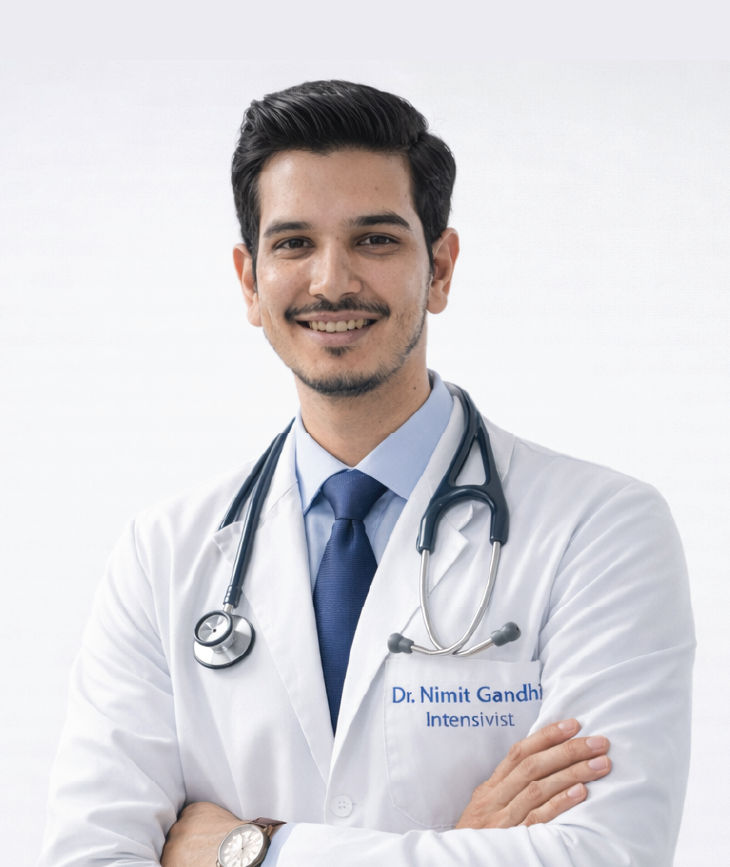
Our Team of Expert Doctors



Talks By Our Expert Critical Care Doctors
After Covid Critical Care Medicine, Patient Feedback Father of Mr. Naman – EPIC
Who Manages the Most Critical Patients in the ICU?
World Sepsis Day
Our Patient Testimonial Critical Care
Who Manages the Most Critical Patients in the ICU?
World Sepsis Day
After Covid Critical Care Medicine, Patient Feedback Father of Mr. Naman – EPIC
Blogs By Our Expert Critical Care
Head Injury Treatment in Ahmedabad - FAQs
When should a head injury be treated as an emergency?
Any head injury with loss of consciousness, confusion, vomiting, severe headache, seizure, unequal pupils, weakness, or deteriorating responsiveness requires immediate emergency attendance at EPIC Multispecialty Hospital. Even seemingly mild head injuries can deteriorate – when in doubt, seek evaluation.
What is a Glasgow Coma Scale (GCS)?
The Glasgow Coma Scale (GCS) scores a patient’s level of consciousness based on eye opening, verbal response, and motor response – each scored separately and summed. A score of 15 is normal; 8 or below indicates severe TBI requiring immediate intensive management.
What is an extradural haematoma?
Extradural haematoma (EDH) is a collection of blood between the skull and the outer covering of the brain (dura mater). It most commonly results from rupture of the middle meningeal artery after a temporal skull fracture. EDH is a surgical emergency – patients may have a lucid interval before rapid deterioration, making speed of diagnosis and intervention critical.
What is diffuse axonal injury?
Diffuse axonal injury (DAI) occurs when rapid deceleration forces cause widespread shearing of axonal fibres throughout the white matter of the brain. It is not visible on CT but shows on MRI brain. DAI is the most common cause of persistent vegetative state and severe disability after TBI.
What is raised intracranial pressure (ICP) and how is it managed?
Raised ICP occurs when swelling or bleeding increases pressure within the rigid skull – compressing brain tissue and reducing blood flow. Management includes head elevation, controlled ventilation to maintain normal CO2, osmotherapy with mannitol or hypertonic saline, sedation, and surgical decompression when medical management fails.
What head injury treatments are available at EPIC Multispecialty Hospital?
EPIC Multispecialty Hospital, Ahmedabad provides 24/7 neurosurgical and critical care management for all grades of head injury – from concussion assessment to emergency craniotomy for life-threatening haemorrhage.
Can the brain recover after a severe head injury?
Recovery after severe TBI depends on the extent and location of injury, the speed of initial treatment, and the quality of rehabilitation. The brain has significant neuroplasticity – particularly in younger patients – and meaningful recovery is possible with skilled management. EPIC Hospital’s neuro-rehabilitation team supports patients from the ICU through discharge.
What is the cost of head injury treatment at EPIC Multispecialty Hospital?
Contact EPIC Multispecialty Hospital Ahmedabad for head injury treatment cost information. Cost depends on severity, ICU duration, and whether neurosurgery is required. Cashless insurance facilities are available.